Craven Street Gazette, 22–26 September 1770
Franklin’s joke newspaper, written for the household while Stevenson was away. The manuscript record is in the Franklin–Stevenson–Hewson papers.
Open the sourceBenjamin Franklin at 36 Craven Street, 1757–75
Franklin lived for most of sixteen years in a lodging house off the Strand. This site argues that the household, more than Parliament, shows how an American agent became a revolutionary, and that it also held two enslaved men, which complicates the founder story.
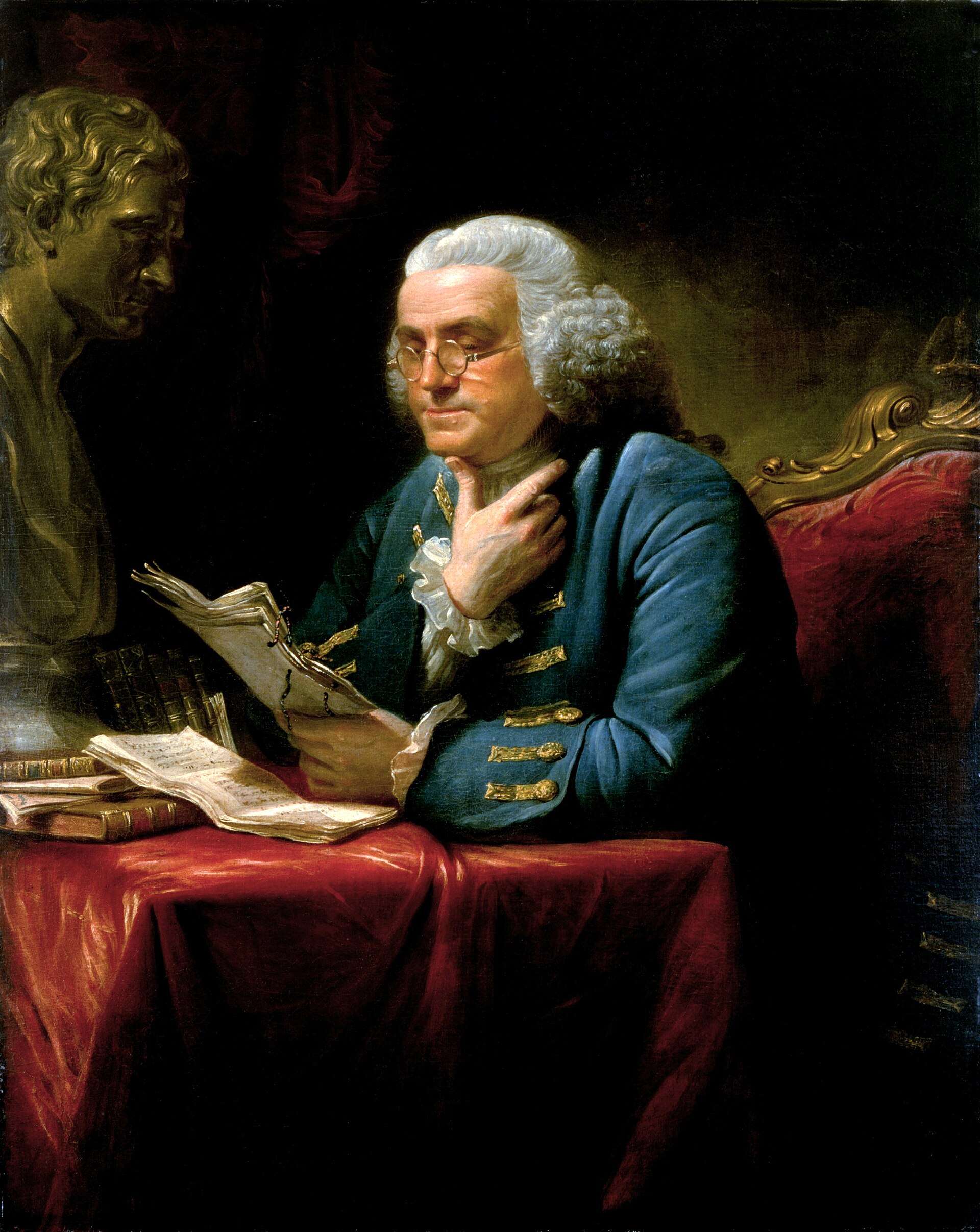
Franklin first lodged with the widow Margaret Stevenson in 1757. The house at 36 Craven Street was built around 1730 as a lodging house and is Grade I listed. He lived there from 1757 to 1762 and again from 1764 until 1775, working as a colonial agent and diplomat.
Stevenson's daughter Polly became one of his regular correspondents. Her husband, William Hewson, ran an anatomy school in the building, and more than 1,200 pieces of bone were found under the old garden in 1998. It was a busy house, not a quiet lodging.
Two sources show how it ran. Franklin's mock newspaper from September 1770 turns the household into a royal court. Stevenson's own letters, spelled as she spoke, give the landlady's side.
Franklin’s joke newspaper, written for the household while Stevenson was away. The manuscript record is in the Franklin–Stevenson–Hewson papers.
Open the sourceAddressed to him in Craven Street. The editors comment on her spelling and on female education.
Open the sourceOn 13 February 1766 Franklin was questioned by the House of Commons, sitting as a committee, about colonial opposition to the Stamp Act. The printed text and the shorthand notes let us compare how it was recorded. Read closely, it shows him playing the part of a reasonable colonist in front of a sceptical room.
Editors’ transcription with notes on the printed text, Franklin’s own notes and Nathaniel Ryder’s shorthand.
Open the sourceA digitised copy of the pamphlet, useful for showing the object as well as the text.
Open the sourceFranklin brought two enslaved men, Peter and King, to Craven Street in 1757. King ran away in 1758. Peter stayed until 1762. Also in 1758 Franklin visited Dr Bray’s schools for Black children, which Benjamin Franklin House presents as a step in his changing views.
The sources here are thin, so the page has to say what we cannot know. The House has done the groundwork and points back to the original advertisements and letters.
The museum’s own account of the two men and what survives about them.
Open the sourceFranklin sent leaked letters by Massachusetts officials, including Governor Hutchinson, to Boston. On 25 December 1773 he publicly admitted it. On 29 January 1774 the Privy Council heard the Massachusetts petition against Governor Hutchinson, and the Solicitor-General, Alexander Wedderburn, spent most of his time attacking Franklin. He was dismissed as deputy postmaster for the colonies soon after.
The contemporary printed account, including the substance of Wedderburn’s speech.
Open the sourceFranklin’s own defence. The editors’ headnote is worth quoting.
Open the sourceAn eyewitness report of the hearing from someone in the room.
Open the sourceBenjamin Franklin House opened to the public on 17 January 2006, Franklin’s 300th birthday, and now tells the story of Peter and King on its own website. A heritage site rewriting its founder narrative is a live example of how Anglo-American memory gets made, and it gives our contemporary section a concrete case rather than a general claim.
Benjamin Franklin 1767.jpg, Wikimedia Commons (https://commons.wikimedia.org/wiki/File:Benjamin_Franklin_1767.jpg). Painting by David Martin, 1767. Licence on the Commons page: public domain.
